Introduction: Why Medical Cleaning Provider Selection Matters
In healthcare environments, cleanliness isn’t just about maintaining appearances—it’s a critical component of patient safety, regulatory compliance, and operational excellence. Every year, healthcare-associated infections (HAIs) affect hundreds of thousands of patients, with inadequate environmental cleaning being a significant contributing factor. For facility managers overseeing medical offices, clinics, hospitals, and surgical centers, selecting the right medical cleaning provider represents one of the most important vendor decisions you’ll make.
Unlike standard commercial cleaning services, medical facility cleaning requires specialized knowledge, rigorous training, and unwavering attention to compliance standards set by OSHA, CDC, and EPA. The wrong choice can lead to failed inspections, patient safety incidents, regulatory fines, and damage to your facility’s reputation. Conversely, the right medical cleaning partner becomes an extension of your healthcare team, actively contributing to positive patient outcomes and operational success.
This comprehensive guide addresses the five most critical questions every facility manager should ask when evaluating medical cleaning providers. These questions, developed through extensive industry research and best practices analysis, will help you identify providers who truly understand the unique demands of healthcare environments and can deliver the specialized OSHA-compliant cleaning services your facility requires.
The High Stakes of Healthcare Cleaning
Healthcare facilities operate under fundamentally different cleaning requirements than typical commercial spaces. While office buildings focus primarily on aesthetics and general cleanliness, medical environments demand hospital-grade sanitation that actively prevents the spread of infectious diseases and maintains strict regulatory compliance.
The stakes couldn’t be higher. According to the Centers for Disease Control and Prevention, healthcare-associated infections affect approximately 687,000 patients in U.S. acute care hospitals annually, resulting in tens of thousands of deaths and billions of dollars in additional healthcare costs. Environmental cleaning plays a crucial role in breaking the chain of infection transmission, making your choice of cleaning provider a direct factor in patient safety outcomes.
Beyond patient safety considerations, medical facilities face intense regulatory scrutiny. OSHA, CDC, and EPA guidelines establish strict standards for cleaning protocols, chemical usage, waste handling, and staff training. Non-compliance can result in significant fines, operational disruptions, and legal liability. Additionally, accreditation bodies like The Joint Commission evaluate environmental services as part of their comprehensive facility assessments.
Ready to assess your current cleaning provider’s compliance standards? Schedule a complimentary facility compliance review with our certified medical cleaning specialists to identify potential risks and improvement opportunities.
The financial implications extend beyond regulatory compliance. Medical facilities that experience infection outbreaks or safety incidents face substantial costs including extended patient stays, additional treatments, legal settlements, and reputation damage that can impact patient volume for years. Conversely, facilities with exemplary cleaning standards often see improved patient satisfaction scores, reduced liability insurance costs, and enhanced reputation within their communities.
For facility managers, this reality means that medical cleaning provider selection must go far beyond comparing basic service costs. The decision requires careful evaluation of specialized capabilities, compliance expertise, training programs, and quality assurance systems that distinguish true medical cleaning specialists from general commercial cleaning companies.

Question 1: Do They Specialize in Medical-Grade Cleaning?
Quick Answer: Medical cleaning providers should specialize in healthcare environments with proper certifications, EPA-registered disinfectants, and equipment designed specifically for infection control and regulatory compliance.
The first and most fundamental question to ask any potential medical cleaning provider is whether they truly specialize in healthcare environments. This distinction goes far beyond marketing claims or general “healthcare experience” listed on company websites. True medical cleaning specialization requires a deep understanding of infection control principles, regulatory requirements, and the unique challenges present in healthcare settings.
Understanding Medical-Grade vs. Commercial Cleaning
Medical-grade cleaning differs substantially from commercial cleaning in several critical areas. While commercial cleaning focuses primarily on aesthetics and general sanitation, medical cleaning prioritizes infection prevention, cross-contamination control, and regulatory compliance. The protocols, products, chemicals, and techniques used in medical environments are specifically designed to eliminate pathogens that pose serious health risks to vulnerable patient populations.
Commercial cleaners typically work with general-purpose disinfectants and follow basic cleaning procedures suitable for office environments. Medical cleaning specialists, however, must understand the specific “kill claims” of various EPA-registered disinfectants, proper dilution ratios, required contact times, and application methods necessary to eliminate healthcare-associated pathogens including MRSA, C. difficile, and other antibiotic-resistant organisms.
The training requirements also differ dramatically. While commercial cleaning staff might receive basic orientation and safety training, medical cleaning professionals require extensive education in infection control protocols, bloodborne pathogen protocols, hazardous waste handling, and specialized cleaning procedures for different types of medical equipment and environments.
Key Indicators of True Medical Cleaning Specialization
When evaluating potential providers, look for specific indicators that demonstrate genuine medical cleaning expertise rather than general commercial cleaning companies attempting to serve healthcare markets. These indicators include:
Specialized Certifications and Training Programs: Legitimate medical cleaning companies invest heavily in staff certification through recognized programs such as industry-recognized qualifications like medical cleaning certification programs. These certifications require ongoing education and demonstrate commitment to maintaining current knowledge of healthcare cleaning best practices.
Detailed Understanding of Regulatory Requirements: True specialists can discuss specific OSHA bloodborne pathogen standards, CDC environmental infection control guidelines, and EPA-registered disinfectant requirements in detail. They should be able to explain how their protocols address specific regulatory requirements and provide documentation of compliance procedures.
Healthcare-Specific Equipment and Supplies: Medical cleaning requires specialized equipment including HEPA-filtered vacuums, microfiber cleaning systems, color-coded cleaning tools, and professional-grade disinfection equipment. Providers should be able to demonstrate their investment in healthcare-appropriate cleaning technology and explain how their equipment selection supports infection control objectives.
Experience with Healthcare Accreditation: Providers with genuine medical cleaning expertise will have experience supporting facilities through Joint Commission surveys, state health department inspections, and other healthcare-specific accreditation processes. They should understand how environmental services contribute to overall facility compliance and patient safety metrics.
Red Flags: When “Healthcare Experience” Isn’t Enough
Many commercial cleaning companies claim healthcare experience without possessing the specialized knowledge necessary for medical environments. Be wary of providers who cannot provide specific examples of their disinfectant protocols for hospitals, rely primarily on general-purpose cleaning products, or cannot discuss regulatory compliance requirements in detail.
Additionally, companies that primarily serve commercial accounts with only limited healthcare clients may not have developed the specialized systems and expertise necessary for consistent medical-grade cleaning. The complexity and risk associated with healthcare environments require providers who have made medical cleaning their primary focus and area of expertise.
At Uni-Pro, every team member receives comprehensive training in medical-specific disinfection protocols, wet-time standards, and compliance requirements. Our specialized focus on healthcare environments means we understand the critical importance of infection control and maintain the expertise necessary to protect patients, staff, and visitors in medical facilities throughout our service area.

Question 2: How Do They Train and Retain Their Staff?
Quick Answer: Professional medical cleaning companies provide comprehensive initial training and ongoing education, focusing on staff retention to ensure consistent, knowledgeable service delivery.
Staff training and retention represent critical factors in medical cleaning quality and consistency. Healthcare cleaning standards evolve continuously as new pathogens emerge, regulations change, and best practices develop. Your cleaning provider’s approach to staff development directly impacts the quality and reliability of services your facility receives.
The Critical Importance of Ongoing Training
Medical cleaning requires far more than basic janitorial skills. Staff must understand complex infection control principles, proper use of specialized chemicals and equipment, regulatory compliance requirements, and facility-specific protocols. This knowledge base cannot be developed through simple orientation sessions or occasional refresher training.
Effective medical cleaning training programs address multiple competency areas including infection control fundamentals, bloodborne pathogen protocols, chemical safety and handling, proper use of personal protective equipment, waste segregation and disposal procedures, and emergency response protocols. Additionally, staff must understand the clinical implications of their work and how proper environmental services contribute to patient safety and positive health outcomes.
The distinction between cleaning, sanitizing, disinfecting, and sterilizing represents fundamental knowledge that every medical cleaning professional must possess. Staff must understand when each level of decontamination is appropriate, which products achieve specific antimicrobial effects, and how to verify that proper procedures have been followed. This technical knowledge requires structured training programs and ongoing competency assessment.
Evaluating Training Program Comprehensiveness
When assessing potential medical cleaning providers, request detailed information about their training programs including curriculum content, training duration, competency assessment methods, and ongoing education requirements. Comprehensive programs typically include both classroom instruction and hands-on practical training with regular competency evaluations.
Initial Training Requirements: Quality medical cleaning companies require extensive initial training before staff begin working independently in healthcare environments. This training should cover infection control principles, regulatory requirements, facility-specific protocols, emergency procedures, and proper use of all cleaning equipment and chemicals. Professional medical cleaning preparation typically requires substantial initial training periods to ensure competency.
Ongoing Education and Competency Assessment: Healthcare cleaning standards evolve continuously, making ongoing education essential. Look for providers who require regular refresher training, competency assessments, and continuing education to maintain current knowledge of best practices and regulatory requirements. Annual training requirements demonstrate serious commitment to staff development and keeping pace with industry standards.
Specialized Training for Different Healthcare Environments: Different types of medical facilities require specialized knowledge and protocols. Surgical suites, patient rooms, laboratories, and emergency departments each present unique cleaning challenges and requirements. Providers should offer specialized training for staff working in different healthcare environments.
Documentation and Certification Tracking: Professional medical cleaning companies maintain detailed training records, competency assessments, and certification tracking for all staff members. This documentation supports regulatory compliance and provides assurance that staff possess current knowledge and skills necessary for medical cleaning work.
The Staff Retention Challenge in Healthcare Cleaning
High staff turnover represents a significant challenge in the cleaning industry, with annual turnover rates often exceeding 100% for commercial cleaning companies. This instability creates serious problems for healthcare facilities that require consistent, knowledgeable staff who understand facility-specific protocols and maintain relationships with healthcare team members.
Frequent staff changes disrupt cleaning consistency, require repeated training investments, and create security and access control challenges for healthcare facilities. Additionally, inexperienced staff are more likely to make errors that could compromise patient safety or regulatory compliance.
How Uni-Pro Addresses Training and Retention
At Uni-Pro, we take a fundamentally different approach to staffing that prioritizes retention and continuous development over the industry-standard model of high turnover and constant recruitment. Rather than accepting high turnover as inevitable, we invest in our existing staff through enhanced training, career development opportunities, competitive compensation, and supportive management practices.
Our comprehensive training program includes initial medical cleaning certification, ongoing competency development, and specialized training for different healthcare environments. We enhance our existing staff capabilities rather than constantly replacing team members, reducing costly turnover while improving quality and consistency for our healthcare clients.
This retention-focused approach provides significant benefits for healthcare facilities including consistent service delivery, reduced security and access control concerns, stronger relationships between cleaning staff and healthcare teams, and lower risk of errors or protocol violations that can occur with inexperienced staff.
Our commitment to staff development extends beyond basic cleaning procedures to include professional growth opportunities, leadership development, and career advancement pathways that help team members build long-term careers in healthcare environmental services. This investment in our people translates directly into better outcomes for the medical facilities we serve.
Question 3: Do They Use Compliance-Approved Products and Processes?
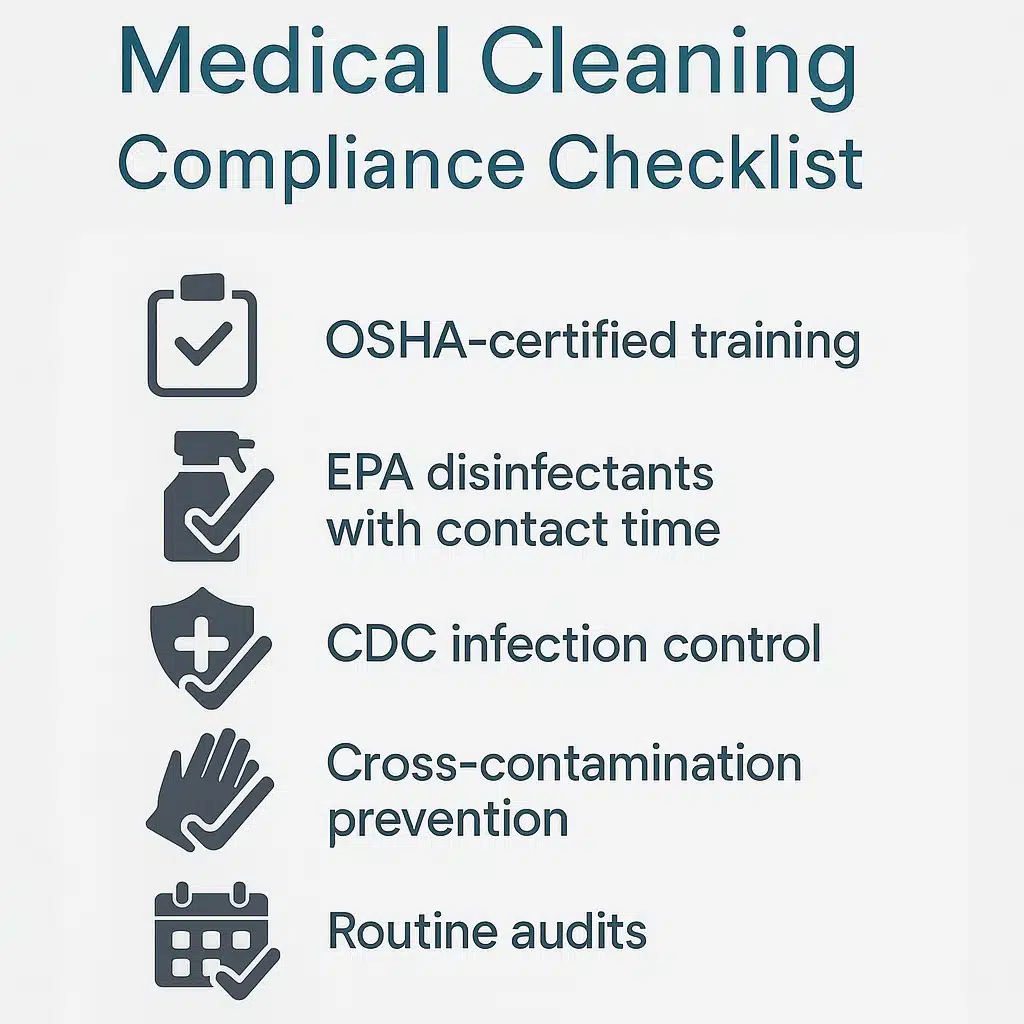
Quick Answer: Medical cleaning providers must use EPA-registered disinfectants, follow proper contact times, maintain OSHA compliance, and understand regulatory requirements from CDC, EPA, and other healthcare authorities.
Product selection and application procedures represent critical components of effective medical cleaning that directly impact patient safety and regulatory compliance. The wrong disinfectant, improper dilution, or inadequate contact time can render cleaning efforts ineffective while potentially exposing your facility to serious liability and regulatory violations.
Understanding Regulatory Compliance Requirements
Medical facilities must comply with multiple overlapping regulatory frameworks that govern cleaning products, procedures, and documentation. The Occupational Safety and Health Administration (OSHA) establishes workplace safety standards including bloodborne pathogen protocols and chemical safety requirements. The Centers for Disease Control and Prevention (CDC) provides evidence-based guidelines for infection prevention and environmental cleaning in healthcare settings. The Environmental Protection Agency (EPA) regulates antimicrobial products and establishes efficacy standards for disinfectants used in healthcare environments. These comprehensive guidelines are detailed in the CDC Environmental Cleaning Guidelines PDF, which provides facility managers with specific protocols and best practices for healthcare environmental services.
These regulatory requirements are not suggestions or best practice recommendations—they represent legally binding standards that healthcare facilities must follow to maintain operating licenses and avoid penalties. Failure to comply with these standards can result in significant fines, operational restrictions, and legal liability in the event of patient safety incidents.
The complexity of these requirements means that medical cleaning providers must possess detailed knowledge of regulatory standards and maintain current awareness of changes and updates. This expertise cannot be developed through casual familiarity or general cleaning experience—it requires dedicated study and ongoing education in healthcare-specific regulatory requirements.
EPA-Registered Disinfectants and Kill Claims
One of the most critical aspects of medical cleaning involves proper selection and use of EPA-registered disinfectants. Unlike general-purpose cleaners used in commercial environments, medical facilities require disinfectants that have been specifically tested and approved for use against healthcare-associated pathogens.
EPA registration involves rigorous testing to verify that disinfectant products can eliminate specific microorganisms under defined conditions. These “kill claims” specify which pathogens the product can eliminate, required contact times, appropriate dilution ratios, and application methods. Medical cleaning providers must understand these specifications and ensure their protocols align with EPA-registered product requirements.
Different healthcare environments and contamination scenarios require different disinfectant products. Terminal cleaning following patient discharge requires broad-spectrum disinfectants effective against multiple pathogen types. Surgical suite cleaning may require sporicidal products effective against Clostridium difficile spores. Blood spill cleanup requires products specifically approved for bloodborne pathogen decontamination.
The selection process becomes even more complex when considering compatibility with different surface materials, environmental factors that affect product efficacy, and potential interactions between different cleaning chemicals. Professional medical cleaning providers must possess comprehensive knowledge of product selection criteria and maintain current awareness of new products and changing recommendations.
The Critical Importance of Proper Contact Time
One of the most frequently overlooked aspects of medical disinfection involves proper contact time, also known as “wet time” or “dwell time.” This refers to the amount of time a disinfectant must remain wet on a surface to achieve its claimed antimicrobial efficacy. Contact times vary significantly between different products and target pathogens, ranging from 30 seconds to 10 minutes or more.
Many cleaning companies, particularly those without specialized medical training, fail to observe proper contact times in their rush to complete cleaning tasks efficiently. This fundamental error can completely negate the antimicrobial effectiveness of even the most powerful disinfectants, leaving surfaces contaminated despite appearing clean.
Professional medical cleaning requires systematic approaches that ensure adequate contact times are maintained throughout the cleaning process. This may involve applying disinfectants to multiple surfaces sequentially, allowing proper dwell time while cleaning other areas, and returning to complete the process once contact time requirements have been met.
How Uni-Pro Ensures Compliance Excellence
At Uni-Pro, we maintain rigorous compliance standards that exceed regulatory requirements and provide additional assurance for our healthcare clients. Our product selection process involves careful evaluation of EPA registrations, kill claims, safety profiles, and compatibility with healthcare environments and equipment.
We use only EPA-registered disinfectants that have been specifically approved for healthcare use and match each product to its appropriate application based on pathogen targets, surface materials, and environmental conditions. Our staff receive comprehensive training in proper product selection, dilution procedures, application methods, and contact time requirements.
Our compliance program includes regular auditing of product usage, procedure adherence, and documentation practices to ensure consistent compliance with all applicable regulatory standards. We maintain detailed records of product specifications, training completion, and quality assurance activities to support facility compliance documentation and regulatory inspections.

Question 4: How Do They Prevent Cross-Contamination?
Quick Answer: Effective cross-contamination prevention requires color-coded cleaning systems, zone-based protocols, HEPA-filtered equipment, and rigorous staff hygiene standards to prevent pathogen transfer between spaces.
Cross-contamination prevention represents one of the most critical aspects of medical cleaning that distinguishes healthcare environmental services from commercial cleaning. The inadvertent transfer of pathogens between different areas of a medical facility can have devastating consequences for patient safety and can undermine even the most rigorous cleaning efforts.
Understanding Cross-Contamination Risks in Healthcare
Healthcare facilities present unique cross-contamination challenges due to the presence of vulnerable patient populations, infectious diseases, and complex workflows that involve movement of people, equipment, and materials throughout the facility. Unlike commercial environments where contamination risks are generally limited to common cold viruses and routine bacteria, medical facilities must address serious pathogens including antibiotic-resistant organisms, bloodborne pathogens, and other infectious agents that pose significant health risks.
Cross-contamination can occur through multiple pathways including contaminated cleaning equipment, improper cleaning cloth usage, inadequate hand hygiene, contaminated cleaning solutions, and failure to follow proper cleaning sequences. Each of these pathways requires specific prevention strategies and systematic controls to minimize contamination risks.
The consequences of cross-contamination in healthcare settings extend far beyond individual patient impacts. Healthcare-associated infection outbreaks can affect multiple patients, require extensive contact tracing and testing, result in facility closures or service restrictions, and generate significant legal and financial liability. Prevention of cross-contamination therefore represents both a patient safety imperative and a critical risk management priority.
Color-Coded Cleaning Systems
One of the most effective strategies for preventing cross-contamination involves implementation of color-coded cleaning systems that designate specific cleaning tools and supplies for different areas or types of contamination. These systems provide visual cues that help staff avoid inadvertent cross-contamination while supporting consistent application of appropriate cleaning protocols.
Effective color-coding systems typically designate different colors for high-risk areas such as patient rooms and surgical suites, moderate-risk areas such as corridors and waiting rooms, and low-risk areas such as administrative offices and public spaces. Additional color designations may be used for specific applications such as blood spill cleanup, isolation room cleaning, or restroom sanitation.
The implementation of color-coded systems requires comprehensive staff training, clear documentation of color assignments and usage protocols, regular auditing to ensure compliance, and systematic replacement of cleaning tools to maintain color integrity. Staff must understand not only which colors to use in different areas but also proper procedures for cleaning and storing color-coded equipment to prevent cross-contamination.
Uni-Pro’s Comprehensive Cross-Contamination Prevention
At Uni-Pro, we implement comprehensive cross-contamination prevention systems that address all potential contamination pathways through systematic controls and rigorous staff training. Our color-coded cleaning system separates tools by area and contamination risk, ensuring that equipment used in high-risk areas never comes into contact with lower-risk areas.
Our zone-based cleaning protocols establish clear boundaries between different areas of medical facilities and specify appropriate cleaning sequences, equipment requirements, and safety procedures for each zone. These protocols are customized for each facility based on specific layout, services, and contamination risks.
We invest in professional-grade cleaning equipment including HEPA-filtered vacuum systems, antimicrobial cleaning carts, and specialized disinfection equipment that supports effective contamination control. Our equipment maintenance and replacement programs ensure that cleaning tools remain effective and do not become sources of contamination.

Question 5: What’s Their Quality Oversight Process?
Quick Answer: Quality oversight includes regular inspections, performance metrics tracking, corrective action procedures, customer communication systems, and continuous improvement programs to ensure consistent service delivery.
Quality oversight and supervision represent the foundation that ensures consistent delivery of medical-grade cleaning services. Even the most comprehensive training programs and detailed protocols cannot guarantee consistent performance without systematic oversight, regular quality assessments, and responsive corrective action procedures.
The Critical Role of Supervision in Medical Cleaning
Medical cleaning requires a level of precision and consistency that cannot be achieved through basic task completion alone. Every cleaning activity must be performed according to specific protocols, using appropriate products and procedures, within required timeframes, and with proper documentation. This level of performance requires active supervision and ongoing quality monitoring.
Effective supervision in medical cleaning goes beyond simple task verification to include assessment of protocol compliance, evaluation of cleaning effectiveness, identification of training needs, and proactive problem resolution. Supervisors must possess comprehensive knowledge of medical cleaning requirements and the expertise necessary to evaluate performance against professional standards.
Components of Effective Quality Oversight
Comprehensive quality oversight systems include multiple components that work together to ensure consistent performance and continuous improvement. These components must address both routine monitoring and systematic evaluation of cleaning effectiveness and compliance.
Regular Quality Inspections: Systematic quality inspections provide objective assessment of cleaning performance against established standards. These inspections should evaluate both visible cleanliness and protocol compliance, including proper product usage, contact time adherence, equipment maintenance, and documentation completion.
Performance Metrics and Documentation: Effective oversight requires systematic collection and analysis of performance data including inspection results, compliance assessments, customer feedback, and incident reports. This data provides objective evidence of performance trends and helps identify areas requiring additional attention or improvement.
Corrective Action Procedures: When performance issues are identified, effective oversight systems include clear procedures for corrective action including immediate problem resolution, root cause analysis, additional training or coaching, and follow-up verification to ensure problems have been resolved.
Uni-Pro’s Comprehensive Quality Oversight
At Uni-Pro, we maintain rigorous quality oversight systems that ensure consistent delivery of medical-grade cleaning services and provide healthcare facilities with confidence in our performance. Our hands-on supervisors conduct regular quality inspections using standardized evaluation criteria and provide immediate feedback and corrective action when needed.
Our quality monitoring system includes systematic performance tracking, customer feedback collection, and data analysis that helps us identify trends and improvement opportunities. We maintain detailed documentation of all quality activities and provide regular reports to healthcare facility managers that demonstrate our commitment to excellence.
The True Cost of Choosing the Wrong Provider
While cost considerations inevitably influence vendor selection decisions, facility managers must understand that the apparent savings from choosing lower-cost cleaning providers can result in significantly higher total costs when quality issues, compliance failures, or safety incidents occur.
Healthcare-associated infections represent one of the most serious consequences of inadequate environmental cleaning, with direct costs that can reach tens of thousands of dollars per incident. Regulatory compliance failures can result in significant fines and penalties from OSHA, state health departments, and other regulatory agencies.
Professional medical cleaning services provide value that extends far beyond basic cleaning tasks to include risk mitigation, compliance support, and operational efficiency improvements. This value includes reduced infection risks, regulatory compliance assurance, improved patient satisfaction, enhanced facility reputation, and peace of mind for facility managers.
Your Next Steps: Making the Right Decision
Selecting the right medical cleaning provider requires systematic evaluation of multiple factors beyond basic service costs. The five questions outlined in this guide provide a framework for assessing provider capabilities and identifying companies that possess the specialized expertise necessary for medical environments.
Begin your provider evaluation by developing clear criteria based on your facility’s specific needs, risk factors, and operational requirements. When requesting proposals from potential providers, ask for detailed information about their medical cleaning expertise, training programs, compliance procedures, quality oversight systems, and staff retention strategies.
Consider conducting site visits to observe potential providers’ operations and interview key personnel who would be responsible for your facility’s services. Contact references from current healthcare clients to learn about their experiences with potential providers.
Base your final decision on comprehensive evaluation of provider capabilities, expertise, and fit with your facility’s needs rather than cost considerations alone. The right medical cleaning provider becomes a valuable partner in supporting patient safety and operational excellence.
Conclusion: Protecting What Matters Most
Choosing a medical cleaning provider represents far more than a routine vendor selection decision—it’s a critical choice that directly impacts patient safety, regulatory compliance, and operational success. The five questions outlined in this guide provide a framework for identifying providers who possess the specialized expertise, systematic processes, and professional commitment necessary for medical environments.
The stakes in healthcare cleaning are simply too high to accept anything less than true medical-grade expertise. Healthcare-associated infections, regulatory violations, and safety incidents can have devastating consequences for patients, staff, and healthcare organizations. Conversely, professional medical cleaning services provide essential support for patient safety objectives and operational excellence.
The right medical cleaning provider becomes a trusted partner who understands the unique challenges of healthcare environments and shares your commitment to patient safety and quality care. This partnership provides peace of mind that allows healthcare teams to focus on their core mission of providing excellent patient care while knowing that environmental services are being managed professionally.
About The Uni-Pro Team
This comprehensive guide was developed by the certified healthcare cleaning specialists at Uni-Pro Inc., drawing from decades of combined experience in medical facility environmental services. Our team includes certified healthcare environmental services professionals with advanced training in infection control and regulatory compliance, industry specialists with expertise in healthcare cleaning management standards, OSHA-trained professionals specializing in bloodborne pathogen protocols and workplace safety, and industry veterans with experience supporting Joint Commission surveys and healthcare accreditation processes.
At Uni-Pro, we understand the critical importance of medical cleaning excellence and the trust that healthcare facilities place in their environmental services partners. Our specialized expertise, comprehensive training programs, rigorous quality oversight, and commitment to continuous improvement make us the preferred choice for healthcare facilities throughout our service area.
Ready to experience the difference that true medical cleaning expertise can make for your facility? We invite you to contact us for a comprehensive facility assessment and consultation. Our team of healthcare cleaning specialists will evaluate your current needs, identify improvement opportunities, and develop a customized service plan that supports your patient safety and operational objectives.
Don’t leave your facility’s cleanliness and safety to chance. Partner with Uni-Pro’s certified medical cleaning professionals to ensure full compliance, optimal patient safety, and complete peace of mind.
Contact Uni-Pro today:
- Phone: (516) 510-1336
- Email: info@uni-proinc.com
- Website: uni-proinc.com
Schedule your complimentary facility compliance review and discover how expert medical cleaning can transform your healthcare environment. Let’s work together to protect what matters most—your patients, staff, and reputation.